

Melbourne has overtaken Johor to lead Asia-Pacific for data centre absorption this year. datacenterHawk’s 3Q 2026 APAC report shows 1,546 MW of capacity leased so far in 2026. Johor follows with 1,279 MW, then Jakarta with 973 MW and Sydney with 710 MW.
Why demand is moving south
Power and land are driving the shift. Hyperscalers see Melbourne as offering easier and cheaper access to both, while Sydney is facing tighter grid capacity and higher land costs in its established precincts. Melbourne also still has room for expandable campuses with space for future phases, which Sydney is running short of. Much of the recent activity is hyperscalers expanding close to their existing campuses in Melbourne’s west.
Long lead times for power infrastructure are changing how customers buy. According to datacenterHawk’s analyst, the operators who secure power will be those willing to commit early and lock in their place in the queue.
AI is a major factor
It is hard to separate AI demand from conventional cloud, because hyperscalers are building flexible capacity that can serve both. But the large majority of newly committed capacity is designed for GPU workloads and liquid cooling.
Prices are rising
Melbourne hyperscale rates rose 32 percent between 2025 and 2026, compared with 16 percent in Sydney. That puts Melbourne among the fastest-rising hyperscale markets in the region, alongside Seoul, Osaka, Tokyo and Singapore. Across Asia-Pacific, vacancy has fallen to 2.96 percent from 7.3 percent a year earlier, and 94 percent of 2026 leasing was preleased.
Commitments are firm
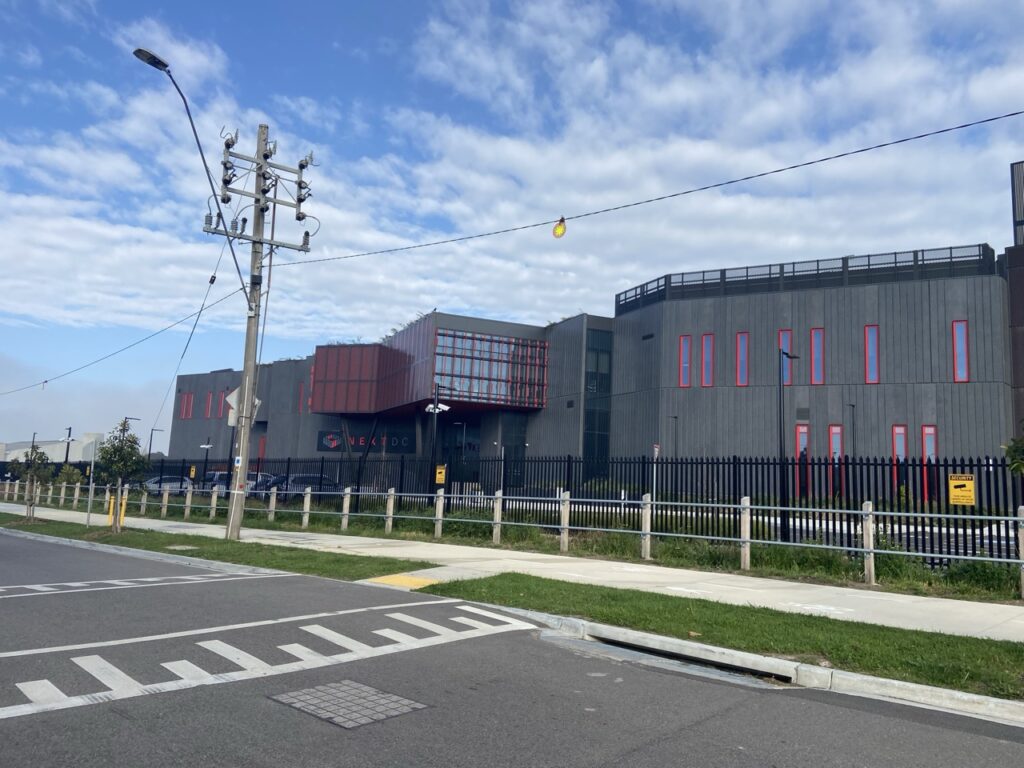
The report found no sign of speculative over-ordering in Australia. Capacity is generally not built without firm customer commitments, usually phased over several years and backed by signed agreements. These contracts can include rights of first refusal or time-limited reservations, which make it costly to hold capacity that won’t be used.
Outlook
Melbourne is expected to keep its lead in the near term, supported by the volume of capacity already pre-committed.
What this means for Inligo and our Customers
Growth on this scale depends on strong connectivity. Data Centre campuses are only as valuable as the networks that link them to each other, to other cities and to the world. As capacity concentrates in Victoria, South Australia and New South Wales the routes and facilities that connect it to the rest of Australia and to international cables become increasingly important.
Inligo Networks, was created to meet that need. It builds, owns and operates Cable Landing Stations, Intermediate Network Node locations and the Unite Cable System, a hyperscale optical fibre network linking Darwin, Adelaide, Melbourne, Sydney and Canberra. Unite is designed for low latency, with traffic taking the shortest possible path between major markets, and for dependable service using Raman amplification technologies.
Together, these assets give data centre developers, hyperscalers and carriers a way to add route diversity, interconnect closer to where demand is growing, and plan their network alongside their campuses rather than after them. As the datacenterHawk report shows, the operators who commit early are the ones who secure capacity, and the same applies to connectivity.
Source: datacenterHawk, APAC Data Center Market Report, 3Q 2026.