
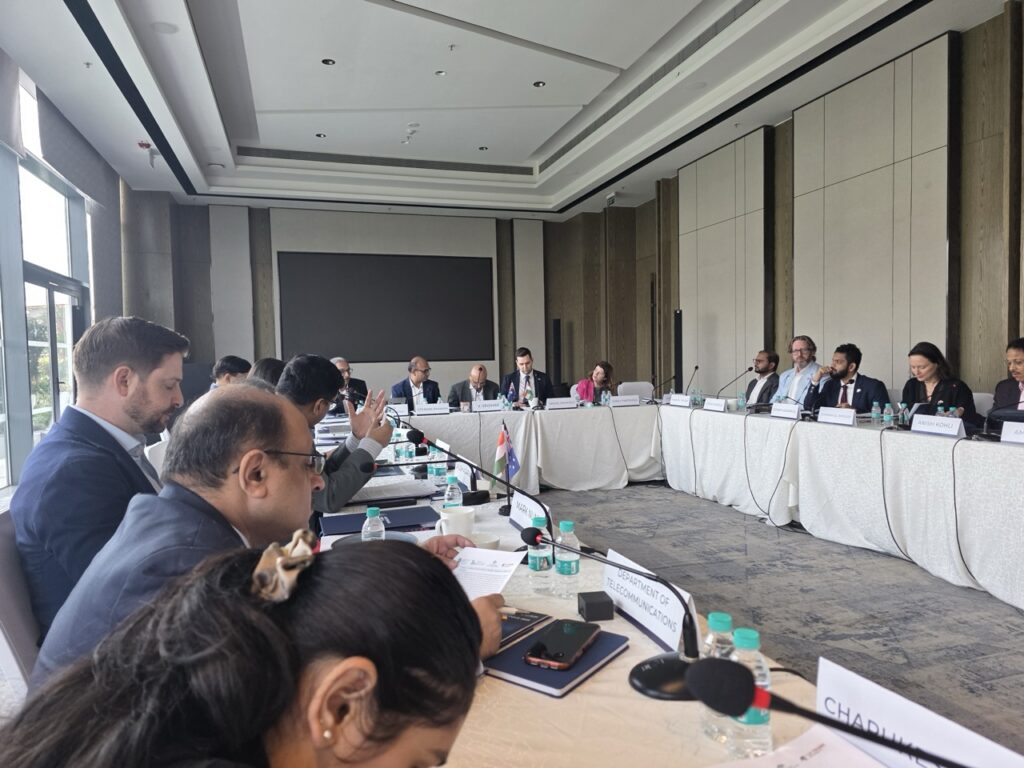
Inligo was pleased to take part in the Australia-India Cables Dialogue 2026, held in Mumbai on Friday 20 November. Our Group Chief Technology Officer, David Robertson, spoke at the event, which brought together Australian, Indian and regional leaders from industry, government, investment and research to look at how the two countries can make submarine cable supply chains more secure and resilient.
From protecting cables to securing the supply chain
Submarine cables carry about 99 per cent of international data traffic and form the physical backbone of the Indo-Pacific’s digital economy. Policy attention has traditionally focused on protecting cables and responding to faults. This year’s Dialogue looked further upstream, at the industrial ecosystem that builds, lays and repairs them.
That ecosystem is highly concentrated. A small number of firms dominate manufacturing, specialised components, cable-laying vessels and repair capability, and recent incidents in the Indo-Pacific and elsewhere have shown how this affects repair timelines, procurement options and long-term network planning. For Australia and India, it shapes which systems to build, where to land them, who to partner with and how to finance them over a 25-year cable lifecycle.
The discussion covered five areas: supply chain vulnerability and resilience; manufacturing capability, components and trusted suppliers; cable deployment and repair capacity; investment, financing and industrial partnerships; and bilateral and regional policy coordination.
Government commitment on both sides
Both governments treat cable resilience as a strategic priority. Under the 2026 Australia-India Partnership on Cyber, Critical Technologies and Supply Chains, they have committed to supporting “secure, trusted, reliable and resilient undersea cable connectivity across the Indo-Pacific.”
A second dialogue, building on Perth

The Dialogue follows the inaugural edition in Perth in July 2025. It was hosted by the Australia India Institute at the University of Melbourne, the International Institute of Information Technology, Bangalore, and the La Trobe Centre for Global Security at La Trobe University. It is supported by a multi-year grant from the Australian Department of Foreign Affairs and Trade under its Australia-India Cyber and Critical Technology Partnership program. Delegates also joined a site visit and dinner on Thursday 19 November.
One of the key takeaways for me was that resilience needs to be considered right from the design stage. Decisions around route diversity, cable burial and monitoring can make a significant difference to how often a system experiences faults and how quickly it can recover. It’s also critical that repair arrangements are secured as part of the initial build, rather than treated as an afterthought. This is particularly important across the Eastern Indian Ocean and Timor Sea region, where vessel availability can have a major impact on repair timelines. Just as importantly, we need to continue supporting trusted regional partners with the practical infrastructure and capabilities they need, including landing infrastructure in our case through Indonesia, Australia and East Timor.
David Robertson, Group Chief Commercial Officer, Inligo Networks
Why this matters to Inligo and the region
Australia’s northern approaches, through Darwin, Dili and the Indonesian archipelago, are among the most important and least served connectivity corridors in the Indo-Pacific. They link Australia to Southeast Asia and, beyond it, to India and the wider region. Subsea cables here are exposed to the same pressures the Dialogue examined: concentrated suppliers, limited repair capacity and growing strategic attention. For Inligo, these are practical questions. Through the Asia Connect Cable and our landing station in Dili, Inligo is working to bring trusted, resilient connectivity to this corridor, with Darwin as the Australian gateway and Indonesia as the key regional neighbour. Getting supply chains, repair arrangements and protection right from the start is what makes these systems dependable for the countries and businesses that rely on them.
We thank the Australia India Institute, IIIT Bangalore, La Trobe University and DFAT and Dr. Samuel Bashfield for convening a valuable discussion.