
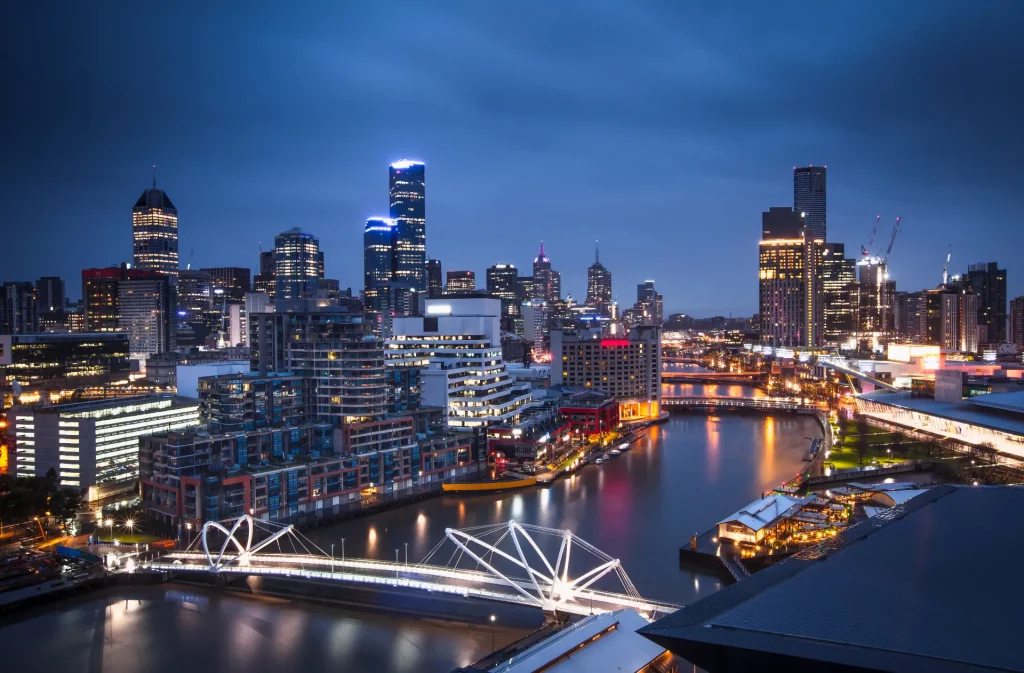
While Sydney’s finance and government links have long made it Australia’s historical answer for tech investment, the actual data on where AI companies are founding, funding, and headquartering paints a different picture — one where Melbourne has pulled narrowly but decisively ahead.
The headline figure comes from the Department of Industry, Science and Resources: Melbourne’s CBD is Australia’s largest single AI company cluster, hosting 188 AI companies against Sydney’s CBD cluster of 184. Victoria is home to more than 20% of the nation’s AI startups and scaleups overall, spanning healthtech, agtech, legal tech and financial services. As of August 2026, Tracxn counts 39 funded AI companies in Melbourne alone, with eight new AI startups founded in the city so far this year.
The company-by-company picture backs this up. Heidi Health, Melbourne’s fastest-growing AI healthtech story, builds an AI-powered medical scribe platform that transcribes doctor-patient consultations into structured clinical notes. Founded in 2021, it has raised close to $100 million, including a Series B round that valued the company at somewhere between $465 and $711 million.
Isaacus is building foundational AI models specifically for the legal technology sector. Apromore has developed an AI-powered process mining platform that creates a “digital twin” of a company’s operations. Affinda automates document processing and data extraction for enterprise clients, while Sapia.ai and Vervoe apply AI to hiring and skills assessment, and Andromeda Robotics is bringing AI-driven automation into manufacturing.
The telecommunications connectivity layer underpinning all of this is increasingly Melbourne-based too. Inligo Networks, Australian-owned with its Australian headquarters in Melbourne’s CBD, is building the Unite Cable System — a terrestrial fibre backbone rolling out in stages to link Darwin, Adelaide, Melbourne, Sydney and Canberra, with a minimum capacity of 23 Tbps per fibre pair. Telstra also Melbourne headquartered is building the Aura Network between Melbourne, Canberra, Sydney and Perth connecting AI Hubs primarily located on the east coast.
Rather than treating Melbourne as an isolated cluster, the Unite Cable System is designed to interconnect Melbourne’s AI hubs directly with Sydney, Adelaide, Darwin and Canberra’s own data centre and AI infrastructure, stitching the country’s major AI hubs into a single high-capacity network rather than leaving them as disconnected regional pockets.
Unite is designed to also connect Australia’s subsea cable gateways in primarily Darwin, Sydney, and Melbourne.
Positioned explicitly to serve AI factories, neo-cloud providers and data centres, that interconnection is exactly what a national AI compute market needs to function efficiently — and gives Melbourne’s ecosystem a direct, low-latency link to the country’s other AI centres rather than operating remotely from them.
At the infrastructure end, Firmus raised a combined $830 million across two 2025 rounds and has since partnered with Nvidia on Project Southgate, a $2.9 billion renewable-powered data centre programme with its first Melbourne-based phase alone valued at $4.5 billion.
That project sits alongside a broader wave of Melbourne data centre investment — from Keppel’s $10 billion Hazelwood campus to NextDC‘s Fishermans Bend expansion — that’s turning the city into the physical backbone for the AI companies choosing to headquarter there. NextDC’s ambitions in the Geelong corridor came into much sharper focus at its FY26 results briefing on 28 August 2026, when CEO Craig Scroggie disclosed a capacity figure for M5 for the first time: 1,200 megawatts of IT load, referring to it as “the recently acquired Melbourne M5 site.” That single figure is more than four times NextDC’s entire built portfolio of 288MW, and larger than its two flagship Sydney projects, S4 and S7, combined.
None of this means Sydney’s tech and finance weight disappears overnight — it remains Australia’s larger capital markets hub, but the direction of travel is unambiguous: Melbourne is where more AI companies are choosing to start, where more AI infrastructure and connectivity capital is now flowing, and where the sector’s near-term growth trajectory clearly points.
For investors, policymakers, and companies like an AI Startup weighing where to build their next chapter of Australian AI infrastructure, that trajectory — not historical assumptions about Sydney’s historical primacy — is what actually matters.