
Australia is experiencing a significant wave of data centre development, driven by rapid growth in cloud computing, artificial intelligence (AI), digital services, and increasing demand for secure data storage. Major global technology companies, including hyperscale cloud providers, are investing heavily in Australian facilities to support both domestic and regional digital infrastructure. Cities such as Sydney and Melbourne have emerged as key hubs due to their proximity to business centres, access to reliable power, and connections to international submarine cable networks. At the same time, secondary markets such as Brisbane, Geelong, and Adelaide are attracting investment as operators seek geographic diversity and lower-cost expansion opportunities.
The expansion of data centres is expected to have a profound impact on Australia’s telecommunications infrastructure. Data Centres rely on high-capacity, low-latency connectivity to transfer vast quantities of information between businesses, consumers, cloud platforms, and international networks. As a result, telecommunications carriers are being required to significantly expand fibre-optic networks, increase transmission capacity, and develop more resilient backhaul infrastructure.
One of the most significant consequences will be the accelerated deployment of metropolitan and intercity fibre networks. Data Centres often serve as aggregation points for digital traffic, creating demand for dense fibre connectivity between facilities, enterprise customers, and internet exchange points. This will encourage telecommunications providers to invest in new fibre routes and redundant network paths, improving overall network resilience and reducing latency across the country.
The growth of data centres is also expected to stimulate investment in international connectivity. Australia’s location and increasing role as a regional digital gateway are driving demand for additional submarine cable systems linking the nation to Asia, North America, and other global markets. Enhanced international connectivity will improve network performance, support digital trade, and increase Australia’s attractiveness as a destination for technology investment.
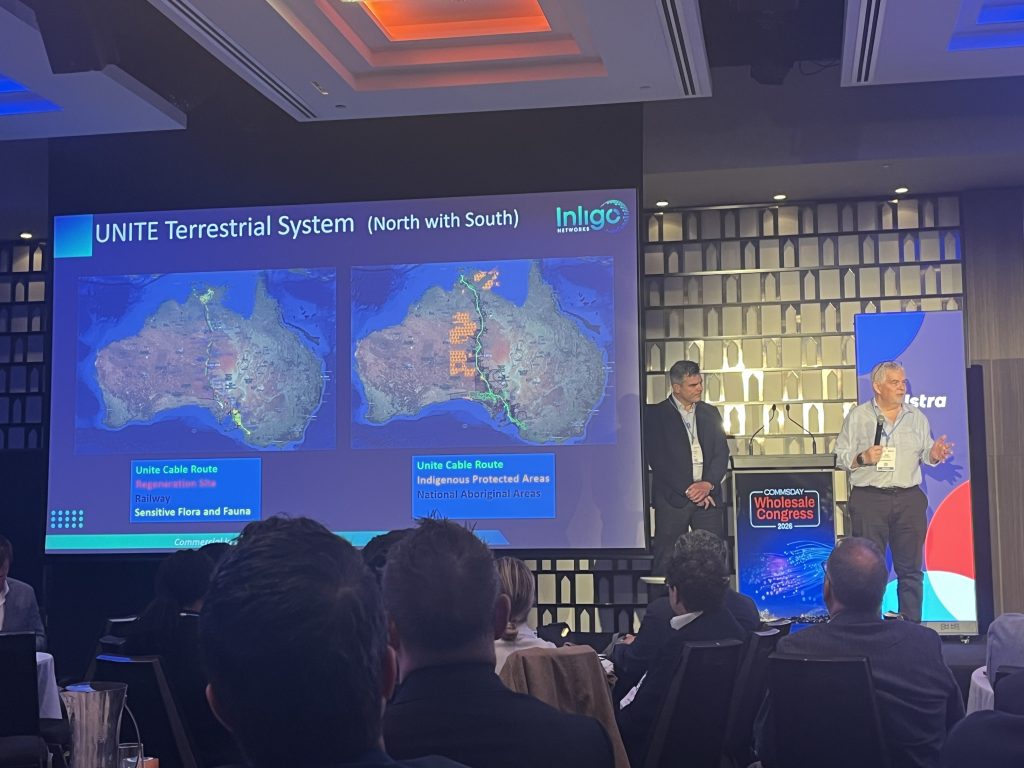
A particularly important development is the emergence of the Inligo Networks Unite Cable System and the associated Asia Connect Cable System (ACC-1), which together are positioning Darwin as a critical digital gateway for Australia. The Unite Cable System is a high-capacity terrestrial fibre network that is connecting Darwin with Adelaide, Melbourne, Sydney, Canberra and Geelong, while ACC-1 will provide new international connectivity linking Australia to Singapore, Indonesia, the Philippines, Guam and the United States. By integrating these networks through the Darwin Cable Landing Station, the projects will create an alternative, low-latency pathway for data traffic between Australia, Southeast Asia and North America, improving network resilience and reducing reliance on existing east coast routes.
These investments are also expected to attract additional data centre development to South Australia the Northern Territory, establishing the Darwin Digital Gateway as a strategically important hub for telecommunications, cloud services and emerging digital industries.